Google AI search for tradies in Australia
How to Help Google AI and ChatGPT Find Your Trade Business
The practical work is less mysterious than the sales pitch. Make your trade, service area, contact details and proof clear in public places that search tools can crawl.
Direct answer
To improve your chance of appearing in Google AI search or ChatGPT Search, keep one accurate Google Business Profile, publish clear service and location facts on a crawlable website, add matching structured data, and build real public proof through reviews and reputable mentions. There is no special “AI ranking” switch, and no agency can guarantee a recommendation.
Start with facts. Fix one thing at a time. Do the basics well.
Use one business name. Use one phone number. Name the work.
Name the area. Show real proof. Keep it plain. Keep it true.
Fix old facts. Check each link. Write for people.
Google’s own guidance says the normal foundations of Search still apply to its generative AI features. Important content needs to be crawlable, internally linked and visible as text. Structured data should match what a visitor can see on the page.
For ChatGPT Search, OpenAI provides a separate search crawler called OAI-SearchBot. Allowing that crawler makes a site eligible to appear in ChatGPT search answers. It does not guarantee that the site will be selected or cited.
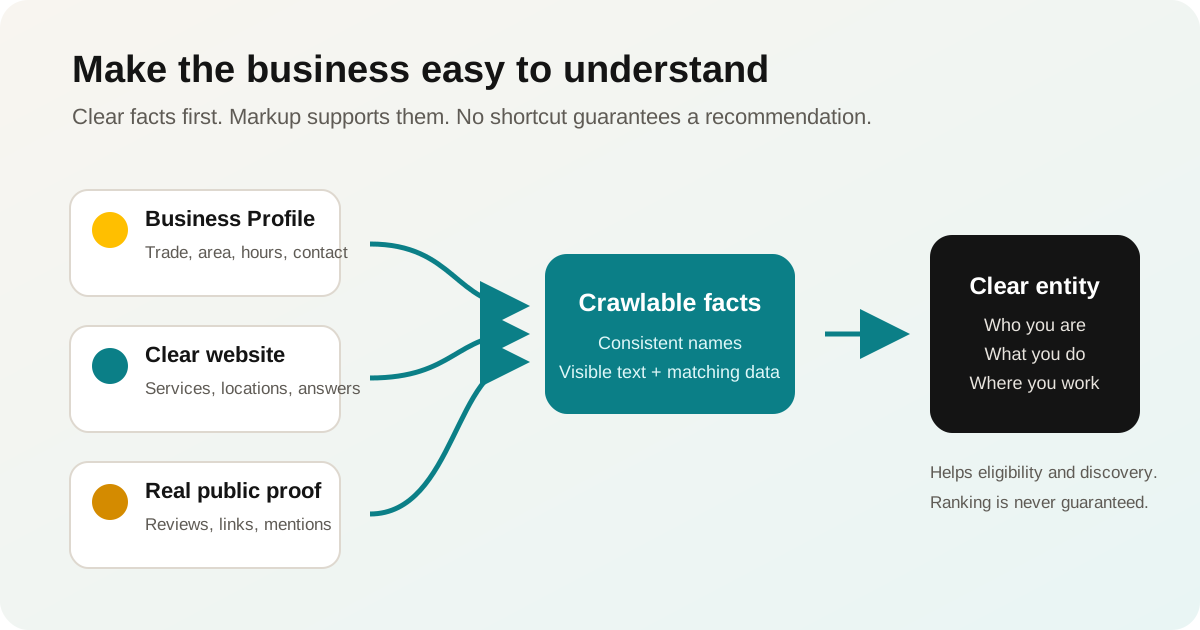
The four facts search tools need to understand
A useful starting test is whether a stranger could answer four questions from your public pages without guessing:
- Who is the business? Use the same trading name, phone number and website across your public profile and website.
- What work does it actually do? Name real services in plain language: emergency plumbing, switchboard upgrades, roof repairs or bathroom waterproofing.
- Where does it work? State the genuine service area. Do not create dozens of copied suburb pages with only the place name changed.
- Why should anyone trust it? Show licences where relevant, real project evidence, real reviews and independent mentions. Never invent proof.
If one of those facts changes between your Google Business Profile, website and other listings, a person sees confusion. A search system sees the same problem at scale.
How Google ranks local trade businesses
Google describes three main factors for local results: relevance, distance and prominence.
| Factor | Plain-English meaning | What a tradie can control |
|---|---|---|
| Relevance | How well the business matches the work being searched for. | Accurate categories, services, page copy and complete business details. |
| Distance | How far the business is from the search location or the person searching. | A truthful address or service area. You cannot manufacture proximity. |
| Prominence | How well known and well supported the business appears online and offline. | Real reviews, reputable links, local mentions and consistent public information. |
AI-generated search features do not cancel those basics. Google says there are no extra technical requirements or special schema needed just to appear in AI Overviews or AI Mode. A strong page still needs to be useful, accessible to Google and supported by honest evidence.
No one can sell a guaranteed local rank. Google says there is no way to request or pay for a better local ranking. Distance also changes from one searcher to another, so a screenshot from one suburb is not universal proof.
Eight steps to make a tradie website easier to find
- Claim and verify the Google Business Profile. Verification tells Google that the business is authorised to manage the profile. Use the real trading name. Do not stuff services or suburbs into the name unless they are genuinely part of it.
- Complete every useful profile field truthfully. Choose the closest primary category, add relevant secondary categories, list real services, keep hours current and use the correct phone and website. For a service-area business, follow Google’s address and service-area rules rather than displaying an address where customers are not served.
- Put the main business facts in visible website text. Your homepage should state the trade, genuine area, core services and a clear contact path. Do not hide the only useful description inside an image, animation or script that a crawler may not read.
- Create service pages only when each page has a real job. A page about switchboard upgrades can explain warning signs, the work involved and what information helps with a quote. Fifty copied suburb pages are not the same thing. Google treats scaled, low-value pages made mainly to manipulate rankings as spam.
- Add LocalBusiness structured data that matches the page. Markup can identify the business name, website, phone, address or service information in a machine-readable form. It supports understanding; it is not a ranking coupon. Never add ratings, prices or locations that are not visibly true on the page.
- Answer the questions customers ask before calling. Publish a clear page when the answer is genuinely useful: what affects a quote, when a job is urgent, what photos to send, or what happens on the first visit. Lead with the answer. Cite official rules when safety, licensing or compliance is involved.
- Build proof in places you do not control. Ask real customers for honest reviews without scripting the praise. Keep industry and local directory details accurate. Earn mentions from suppliers, associations, community groups or project partners when there is a genuine relationship.
- Keep discovery routes open. Maintain a valid robots file and XML sitemap. Submit the sitemap in Google Search Console. If ChatGPT Search matters, allow OAI-SearchBot and the published OpenAI search IP ranges. Decide separately whether to allow GPTBot, which OpenAI uses for model training rather than search discovery.
Work from home and visit customers? Use the Google Business Profile service-area guide for Australian tradies to choose the correct profile type, hide a private address and prepare for verification.
If reviews are the next weak spot, use the fair Google review request guide for Australian tradies. It covers neutral wording, review gating, incentives and a direct-link workflow.
Google AI Search and ChatGPT Search are not the same
Both need public information they can access, but the controls and source systems differ.
| Question | Google AI features | ChatGPT Search |
|---|---|---|
| Main discovery control | Googlebot access and normal Google indexing. | OAI-SearchBot access for search-result inclusion. |
| Local-business foundation | Google Business Profile plus the website and wider public signals. | Crawlable web sources and the sources ChatGPT Search chooses for the query. |
| Special AI schema required? | No. Google says normal structured-data rules apply. | No special ChatGPT schema is published. |
| Guaranteed inclusion? | No. | No. |
This is why “submit your business to every AI” is usually the wrong first job. Start by fixing the source facts. A broken phone number repeated across five platforms is not five authority signals. It is one error copied five times.
AI search shortcuts that can hurt instead
- Copied suburb pages: changing only the suburb name creates little value and can split attention across weak pages.
- Fake reviews or ratings: these mislead customers and can breach platform rules. Do not add review schema for reviews that do not exist.
- Unsupported “number one” claims: rankings change by location, query and time. A selective screenshot is not a durable claim.
- Hidden keywords: text that users cannot see is not a clever signal. It is a spam pattern.
- Schema that contradicts the page: machine-readable claims must match visible content.
- Bulk AI articles with no real answer: publishing volume does not repair missing expertise, weak sourcing or duplicate intent.
The safe test is simple: would the page still deserve to exist if Google sent it no traffic this month? If it helps a customer understand a job, prepare for a quote or choose safely, it has a real purpose.
A 30-minute AI search check for a trade business
Use this before paying for any “AI visibility” package:
- Search the business name. Confirm the correct website, phone and profile appear.
- Open the Google Business Profile. Check the category, hours, service area and website link.
- Read the homepage without the images. The trade, area and main services should still be obvious.
- Test three important pages on a phone. Make sure text loads, links work and no popup blocks the answer.
- Open `/robots.txt` and `/sitemap.xml`. They should be real text or XML files, not an error page or app screen.
- Compare the facts. Fix any mismatch in names, numbers, addresses or service areas.
- Check one service page. It should answer a customer question, not repeat the homepage with extra keywords.
- Check public proof. Remove fake or unverifiable claims. Keep real reviews and project evidence easy to find.
Common questions
Do tradies need special AI schema?
No. Google says there is no special schema required for its AI features. Use supported structured data such as LocalBusiness only when it accurately describes visible page content.
Can a tradie pay to rank first in Google’s local results?
No. Google states that businesses cannot request or pay for a better local ranking. Advertising is separate from organic local ranking.
Should GPTBot be allowed for ChatGPT Search?
OAI-SearchBot is the OpenAI crawler tied to ChatGPT search-result discovery. GPTBot is used for model training. OpenAI lets site owners make those choices separately.
How long does AI search visibility take?
There is no honest fixed timeline. Crawlers need to find and process changes, and selection depends on the query, location, competing sources and the evidence available. Track indexing and impressions before judging the work. If a new page is missing, use our Google indexing time and status check before changing the site.
Fix the facts before chasing the rank
Start with the 30-minute check. If the business facts are clear and consistent, the next job is one genuinely useful customer-answer page—not fifty copies.
FreshTech builds Alice Booking Diary for Australian local businesses. See what the Alice Booking Diary does, read why FreshTech exists, or return to the FreshTech guides.
See Alice Booking DiarySources
- Google Search Central: Website guidance for generative AI features, accessed 28 July 2026.
- Google Business Profile Help: Tips to improve your local ranking on Google, accessed 28 July 2026.
- Google Search Central: LocalBusiness structured data, accessed 28 July 2026.
- OpenAI: Overview of OpenAI crawlers, accessed 28 July 2026.
Editorial note: FreshTech Community wrote this guide from current primary documentation. It contains no paid placement, affiliate link, fabricated review or ranking guarantee. Search systems and their documentation can change, so the source links above remain the final reference.