Tradie workmanship guarantee Australia
Should a tradie offer a workmanship guarantee?
Write the promise. Test the cost. Keep the proof.
Direct answer
Only show a workmanship guarantee when it is written, clear and backed by a plan the firm can afford. Australian consumer guarantees may already apply by law. Your guarantee is an extra promise. It does not replace or cut those rights. Before you place a badge on the site, settle the work it covers, the time, the limits, the claim steps and the proof you will keep.
A clear promise can help a buyer feel safer. A vague promise can create a dispute the firm never planned for. The website is not separate from the job. The ACCC says claims on websites must be true, clear and based on sound grounds.
This guide gives an owner a check before a guarantee goes live. It is a broad guide, not legal advice. Building, wiring, plumbing and other licensed work can also have local or contract rules. Check the rules for the work you do.
Know which promise you are making
Australian Consumer Law gives buyers set rights when they buy goods or services. For services, the ACCC says the work must be done with due care and skill. It must be fit for the stated use. It must also be done in a fair time when no time was agreed.
A workmanship guarantee is not the same thing. It is an extra promise made by the firm. It may say the firm will return, redo work or fix a fault if a set problem appears in a set time.
| Point | Rights under the law | Extra workmanship guarantee |
|---|---|---|
| Where it comes from | Australian Consumer Law | The extra promise your firm chooses to make |
| Can the firm remove it? | No. A firm policy cannot take it away | The firm chooses the terms before it offers the promise |
| Time | Depends on the work and what is reasonable | Often states a set period, if the firm chooses one |
| Website role | Do not misstate or cut the buyer’s rights | Explain the extra promise without hiding key limits |
Your terms cannot cut the buyer’s rights under the law. Those rights may last after the written cover ends. Do not write “no warranty” or “claims accepted for 30 days only” as if that ends each legal right.
Pick one of three honest website positions
- Publish a scoped guarantee. Do this when the promise, terms, claim path and cost have been checked. Show a short note and link to the full terms.
- Explain your service standard. You can say how you inspect, document and respond to a problem without inventing an extra duration. Keep each claim true and supportable.
- Hold the badge. If the owner cannot explain the limits, fix or cost, the guarantee is not ready. Fix the process first.
Not each sound firm needs a bold badge. A current licence, clear scope, real job proof, written quote and fair claim path may give a buyer more trust than a large promise with small print.
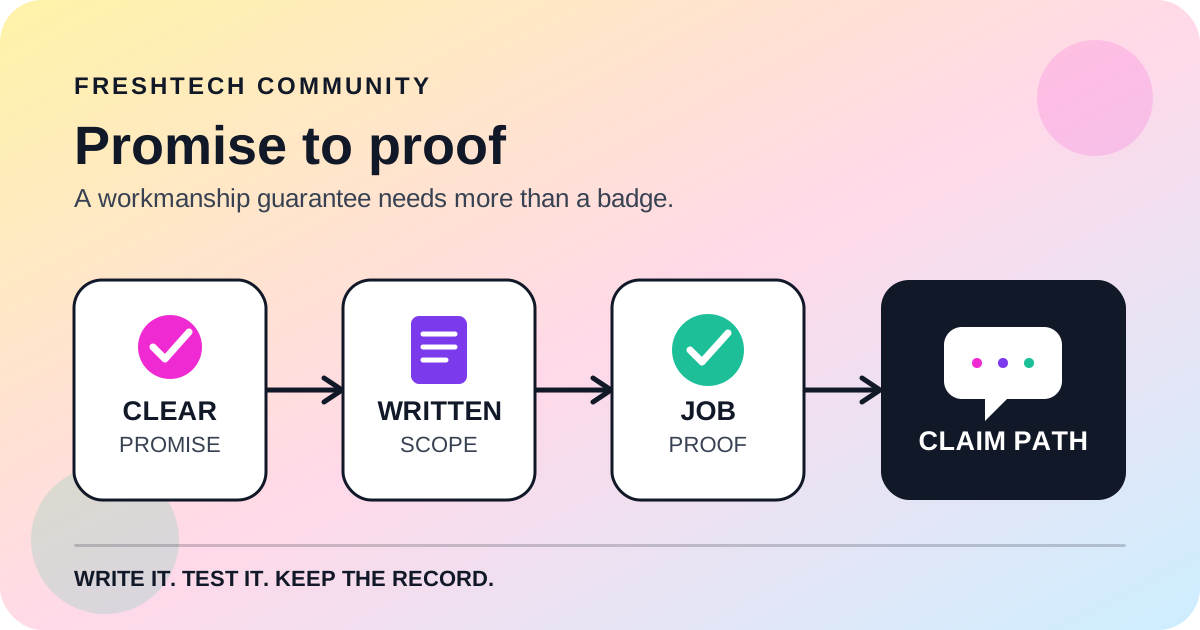
Use the promise-to-proof checklist
Complete every row before the claim is published. A blank row is not a copy problem. It is an operating gap.
| Settle this | Write down | Proof to keep |
|---|---|---|
| Firm | The legal firm making the promise and how to reach it | Current firm name and contact record |
| Eligible work | The work, job types and buyers that are covered | Signed quote, scope and job record |
| Start date | When the period starts: job finish, invoice or one other clear event | Dated finish or hand-off note |
| Duration | The extra period, if one is offered | The version of the terms given for that job |
| Covered problem | What counts as a workmanship fault | Photos, tests, materials and service notes |
| Limits | Fair, clear limits such as misuse, third-party changes or normal wear | Condition report and client instructions |
| Claim route | Who to contact, what to send and the response path | Claim log, messages and inspection booking |
| Fix and costs | What the firm will do and who pays reasonable claim costs | Sign-off and full fix record |
| Product cover | What is labour, what is a product and who handles each issue | Supplier invoice and maker papers |
| Rights under law | How the extra promise sits beside those rights | Checked terms and issue date |
This table helps you plan. It is not a full set of terms. The ACCC says a written warranty against defects must be easy to read and include set facts. Set words may also be required by law. Get advice on the final terms when the promise falls into that class.
Keep the website note short and clear
The main service page should explain the promise in plain words. Put the full terms on a stable page or document. Link it close to the claim. Do not hide the part that changes the meaning.
Safe page plan: “We provide a written workmanship guarantee on covered [service] work. The cover, period, limits and claim steps are set out in our guarantee terms. This extra promise does not limit rights that may apply under Australian Consumer Law.”
Replace the bracketed part with the real service. Do not use this line as legal sign-off. The final words must match the firm’s process and terms.
The short note needs a working link. The linked terms need the same firm, scope and period. Check both after a brand, service or owner change. This is part of normal site care.
Be careful with “lifetime” and other broad claims
“Lifetime” sounds strong, but whose life does it mean? The part, the job, the buyer, the home or the firm? A small note cannot save a headline that gives a false main view.
The ACCC says claims must be accurate, specific and backed by facts. It also says fine print must not conflict with the main message. A broad benefit claim can be misleading when the real cover is narrow.
- Do not pick a long period only because a competitor uses it.
- Do not call product cover a workmanship guarantee.
- Do not hide key limits in a PDF no one can find.
- Do not promise a free fix when call-out, travel or access fees may apply.
- Do not say the guarantee is the buyer’s only fix.
- Do not leave an old promise live after the firm changes its terms.
Separate labour from product cover
A job may include the firm’s work, goods bought from a supplier and parts made by someone else. One fault can link to more than one party. The buyer should not have to guess who to call.
State what your firm covers. State when you will help with a product claim. Keep model names, serial numbers, supplier bills and job notes with the job. Do not tell a buyer to chase the maker if the firm still has a duty as the seller or work firm.
Make the hand-off clear when the job is done. Give the client the job record, care steps and key product papers. Keep your own copy. This helps the firm act well and stops staff relying on memory months later.
Run this six-step pre-publish check
- Map the promise. Complete the promise-to-proof table with the owner and the person who handles complaints.
- Check local rules. Review the state, trade, licence, contract and cover rules that apply to the work.
- Cost the likely claim. Allow for inspection, labour, travel, materials, access and record keeping. A promise the firm cannot fund is not ready.
- Write the full terms. Use plain words. Check the facts and words the law calls for. Get legal advice where the risk or value calls for it.
- Match the website. The badge, short note, service page, quote and full terms must tell the same story.
- Test a claim. Ask a staff member to follow the claim path from a phone. Fix dead links, unclear owners and missing records before launch.
Keep a dated copy of each version. If a claim arrives later, the firm needs to know which promise was given for that job.
Check state and trade rules before naming a period
Do not copy a set time from one more trade or state. Home building work, licensed work and cover plans can have extra rules. The job value and contract may also matter.
Start with the state body where the work is done. Check the licence body and the contract used by the firm. The business.gov.au guide says local fair trade bodies deal with each claim. The NSW Government page is one source of local help. It is not a rule for all trades or all states.
If the firm works across borders, make the check part of job setup. One website line may be read as a promise on every job. Do not publish a national claim until the firm can honour it across the areas it serves.
Common questions
Does every tradie need a workmanship guarantee?
No. Consumer guarantees may already apply by law. A workmanship guarantee is an extra promise. Offer one only when it is clear, backed by facts and useful to the buyer.
How long should a workmanship guarantee last?
There is no safe set time for each trade and job. The period should match the work, parts, risk, local rules and the firm’s means to honour it. The buyer’s rights may last past the written period.
Can I say “lifetime workmanship guarantee”?
Only when “lifetime” has a clear meaning, the limits are fair and visible, and the firm can support the claim. Vague headline wording can give a false impression. Get the final terms checked before publication.
Can the guarantee exclude damage caused by another contractor?
An extra guarantee can have clear and lawful limits. The facts still matter. A limit cannot be used to misstate or remove rights under the law. Record the site state and get advice on the words.
Should the full guarantee be on the website?
Show a clear short note near the claim and link to stable full terms. The buyer should be able to find the firm, scope, period, limits and claim steps before they trust the promise.
What proof should a tradie keep?
Keep the quote, scope, finish date, site and product records, photos, client notes, supplier papers, terms version and each claim step. Store them with the job, not on one worker’s phone.
Write the process before the badge
Fill in the promise-to-proof check. Test one claim from a phone. Then place the short note and full-terms link on the site.
Use our tradie website acceptance checklist to test the full build. If you need help arranging the service proof, claim path and stable terms page, ask FreshTech Community.
See all FreshTech guidesSources
- Australian Competition and Consumer Commission: Warranties, accessed 24 August 2026.
- Australian Competition and Consumer Commission: Consumer rights and guarantees, accessed 24 August 2026.
- Australian Competition and Consumer Commission: False or misleading claims, accessed 24 August 2026.
- Australian Government business.gov.au: Australian Consumer Law and your business, accessed 24 August 2026.
- NSW Government: Receipts and warranties, accessed 24 August 2026.
Editorial note: FreshTech Community made this guide from current Australian Government sources. It gives broad help, not legal advice. It has no affiliate link, paid spot, fake review, made-up warranty period or legal outcome.